
Which Varanasi Ghats Are Best Seen From the River , There’s something profoundly different about experiencing Varanasi from the Ganges itself rather than standing on its famous stone steps. The city that feels chaotic and overwhelming when you’re navigating its narrow lanes suddenly reveals an unexpected grace when viewed from a gently rocking boat. The ghats that seemed like just another set of stairs transform into a magnificent amphitheater of human devotion stretching along the sacred river’s curve.
But here’s the thing—not all ghats are created equal when it comes to river viewing. Some reveal their secrets best when you’re standing on them, participating directly in their rituals and feeling the worn stones beneath your feet. Others, however, truly come alive only when seen from the water’s perspective, where you can appreciate their architectural grandeur, observe the full sweep of activity, and understand how they fit into the larger tapestry of this ancient spiritual landscape.
So which ghats should you prioritize during your boat journey? Which ones offer views from the river that you simply can’t get from land? Let’s explore the Ganges’ most spectacular viewing points and discover why sometimes the best way to experience Varanasi is from the very river that gives the city its soul.
Why the River Offers a Unique Vantage Point
Architectural Beauty From Water Level
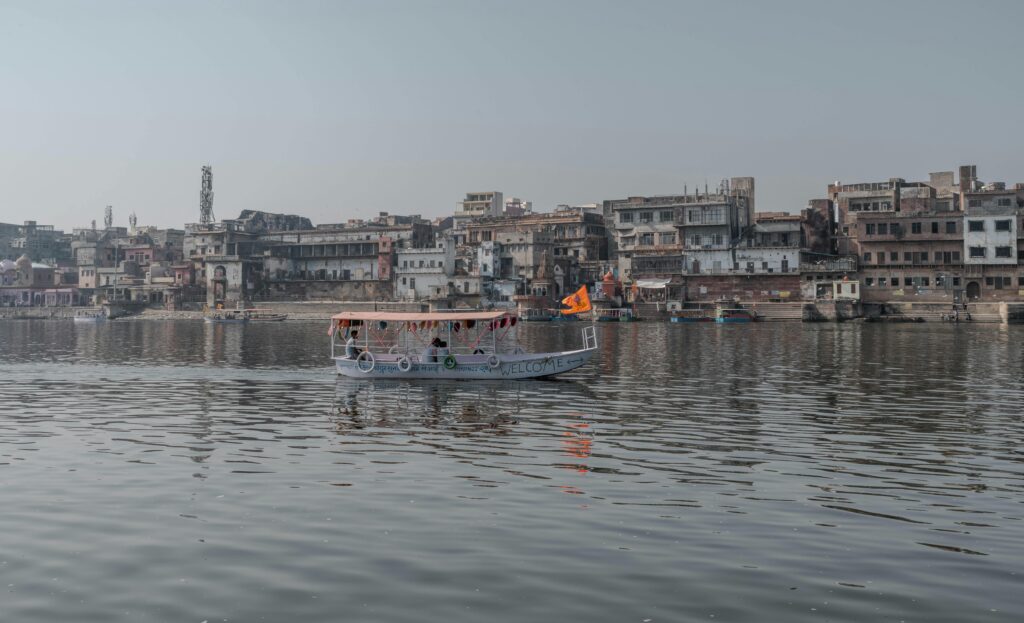
When you’re standing on a ghat, you’re seeing it from inside the experience—you notice the steps immediately in front of you, the temple you’re visiting, the immediate surroundings. But from the river, you see each ghat as it was meant to be seen: as a complete architectural composition rising from the sacred waters to the skyline above.
The palaces, temples, and buildings that line the ghats weren’t designed for close inspection—they were conceived as grand facades meant to impress those approaching from the river, which was historically the primary thoroughfare. The proportions, the symmetry, the way buildings step back in tiers from the waterline—all this makes visual sense only when viewed from boats.
You notice details invisible from land: the intricate patterns of different colored stones, the relationship between adjacent ghats, the way morning or evening light plays across the entire sweep of architecture. It’s like the difference between standing inches from a painting versus viewing it from across the gallery—suddenly you see the artist’s complete vision.
Observing Rituals Without Intrusion
From a boat, you become a respectful observer rather than a participant or intrusive outsider. You can witness morning bathing rituals, prayer ceremonies, even the profound processes at cremation ghats without physically imposing on private spiritual moments or sacred spaces.
This distance creates a natural boundary that allows people on the ghats to continue their devotions without self-consciousness while allowing you to witness these ancient practices with appropriate reverence. You’re close enough to understand what’s happening, far enough to respect the sacred nature of these activities.
The river perspective also provides context that ground-level observation lacks. You see not just one person bathing but hundreds along the entire riverfront, not just one cremation but the continuity of this practice across multiple ghats. This panoramic view helps you understand Varanasi as a living system of spiritual practice rather than isolated incidents.
Photography Opportunities From Boats
For photographers, the river offers unparalleled opportunities. The morning light hits the ghats from behind you, illuminating the architecture and activities beautifully. During evening aarti, you can capture the flames reflected on the water—impossible from land. The gentle movement of the boat adds a subtle dynamism to your shots.
You can photograph the ghats from angles that show their relationship to each other and to the river, capturing the famous crescent curve of Varanasi in ways that reveal why this location has been sacred for millennia. The distance also allows telephoto compression effects that bring architectural elements together dramatically.
Perhaps most importantly, from the river you can photograph without the ethical complications that arise when you’re physically on the ghats. You’re not pointing cameras directly at people’s faces during prayer, not intruding on cremation ceremonies—instead, you’re documenting the larger landscape with individuals as part of that landscape rather than as subjects.
Timing Your Boat Ride for Optimal Viewing
Sunrise Boat Tours
The pre-dawn and sunrise hours offer arguably the most magical river viewing experience. The city awakens gradually—first a few devoted souls beginning their ablutions, then steadily growing activity as the sun colors the sky. The soft morning light is extraordinarily beautiful, painting the ghats in warm golden and pink hues.
Morning boat rides typically launch around 5:00 AM to 5:30 AM, allowing you to be on the water as dawn breaks. The river is relatively calm, the air is cool and fresh, and the spiritual atmosphere is palpable. You’ll witness morning pujas, sun salutations, yoga sessions on the ghats, and the daily ritual of thousands greeting the new day with prayers and holy baths.
This timing is particularly ideal for photographers—the directional morning light creates depth and texture in your images that flat midday light can’t provide. The mist that sometimes rises from the water adds an ethereal quality that makes Varanasi look truly mystical.
Evening Aarti Viewing From Water
The evening Ganga Aarti, particularly at Dashashwamedh Ghat, is spectacular from the river. Boats position themselves in the water starting about 30-45 minutes before the ceremony begins (around 6:00 PM to 7:00 PM depending on season). From this vantage point, you see the entire ceremony unfold—the synchronized movements of multiple priests wielding massive brass lamps, the flames multiplied by their reflections in the Ganges, the massed crowds on the ghat steps.
The experience from water differs dramatically from standing on the ghat itself. Rather than being in the crush of crowds struggling for position, you float peacefully, watching the spectacle from a comfortable distance. The chanting reaches you across the water, the flames are reflected in rippling patterns, and you have an unobstructed view of the complete ceremony rather than a partial glimpse through crowds.
As darkness falls, the ghats become illuminated by thousands of small diyas (oil lamps) that devotees float on the river. From your boat, you’re surrounded by these tiny flickering lights drifting past—a profoundly beautiful moment impossible to experience from land.
Midday and Afternoon Considerations
While most guidebooks recommend sunrise or evening boat rides, midday and afternoon tours have their own advantages despite the heat. The strong overhead light, while less flattering for photography, reveals details of architecture and creates dramatic shadows that emphasize the depth and texture of the ghat structures.
Afternoon rides are typically less crowded with fewer tourist boats, allowing you a more peaceful, contemplative experience. You’ll see different activities—children swimming and playing in the river, dhobis (laundry workers) beating clothes against stones, quieter moments of individual prayer rather than collective ceremonies.
If you’re visiting during winter months (November through February), afternoon warmth is actually pleasant and preferable to early morning cold. The afternoon light during winter months also becomes beautiful earlier, around 3:00 PM to 4:00 PM, combining comfortable temperature with good lighting.
The Most Spectacular Ghats From River View
Dashashwamedh Ghat: The Ceremonial Heart
Dashashwamedh Ghat is Varanasi’s most famous and most visited ghat, and it’s spectacular from the river. The name means “the ghat of ten horse sacrifices,” referencing ancient Vedic rituals said to have been performed here. From the water, you appreciate its central location and the sheer scale of activity.
During evening aarti, this ghat becomes a stage for one of Hinduism’s most elaborate public rituals. Seven priests perform synchronized movements with massive five-tiered brass lamps while standing on individual platforms. The visual impact of this ceremony is maximized when viewed from the river, where you see all seven priests in formation rather than just the one or two visible from most land positions.
The architecture rising behind Dashashwamedh is a jumble of different periods and styles—ancient temples, Maratha-era buildings, more recent constructions—all stacked upon each other in a way that makes visual sense only when you see how the entire composition rises from the riverbank. This layered, organic growth over centuries is the essence of Varanasi, and it’s best appreciated from water.
Assi Ghat: Morning Spiritual Energy
Assi Ghat, at the southern end of the main ghat sequence, is particularly beautiful during morning boat rides. This ghat has strong associations with local devotion—it’s where many Varanasi residents come for their daily ablutions and prayers rather than the more tourist-heavy central ghats.
From the river at sunrise, you witness the “Subah-e-Banaras” (Morning of Varanasi) ceremony where young priests perform a ritual to honor the sun, the river, and Lord Shiva. The sight of these young brahmacharyas (student priests) in their traditional orange and white garments performing synchronized movements against the backdrop of the rising sun is profoundly moving.
Assi Ghat also features a large painted concrete shivling (representation of Lord Shiva) near the water’s edge that becomes an interesting photographic element. The ghat is less monumental architecturally than some others, but from the river, you appreciate its role as a neighborhood gathering place where authentic daily spiritual practice continues relatively untouched by tourism.
Manikarnika Ghat: Sacred Cremation Ground
Manikarnika Ghat is Varanasi’s primary cremation site and one of Hinduism’s most sacred locations. Dying in Varanasi and being cremated at Manikarnika is believed to grant moksha (liberation from the cycle of rebirth). The cremation fires here burn continuously, day and night, year after year, creating a profound reminder of life’s impermanence.
From the river, you witness this sacred process from a respectful distance. You see the pyres burning, the families performing final rites, the woodpiles stacked for future cremations, and the temple dedicated to the goddess Manikarnika looming above. The juxtaposition of death rituals happening alongside regular bathing and prayer rituals creates Varanasi’s unique spiritual intensity.
Photography here requires sensitivity. While you can photograph the ghat’s architecture and the general scene, zooming in on specific funeral pyres or grieving families is deeply disrespectful. The river perspective naturally maintains appropriate distance—you’re documenting the sacred practice as part of Varanasi’s spiritual landscape rather than intruding on individual moments of grief.
The mythology says that the goddess Parvati dropped her earring here when Lord Shiva began his tandava (cosmic dance). The well on the ghat supposedly marks where the earring fell, and bathing here before cremation is considered highly auspicious. From the river, you can appreciate the entire sacred topography rather than just seeing the cremation activity itself.
Harishchandra Ghat: The Second Burning Ghat
Harishchandra Ghat is Varanasi’s second cremation ghat, named after a legendary king known for his truthfulness and righteousness. Less busy than Manikarnika, it nonetheless maintains continuous cremation activity and carries profound spiritual significance.
From the river, Harishchandra Ghat appears more austere than the grander ghats—the architecture is simpler, the atmosphere more somber. The Domed temple and the cremation activity create a powerful visual reminder of mortality that’s central to Varanasi’s spiritual purpose.
What makes this ghat particularly interesting from water perspective is observing how life and death coexist so naturally. Just south of the cremation area, people bathe and perform morning prayers, children play, and daily life continues—this seamless integration of death into life’s daily rhythm is uniquely Varanasi, and it’s most evident when you see the entire ghat system from the river rather than focusing on isolated areas.
Architecturally Stunning Ghats Best Appreciated From Water
Panchganga Ghat: Where Five Rivers Meet
Panchganga Ghat takes its name from the belief that five rivers converge here: Ganges, Yamuna, Saraswati, Kirana, and Dhutpapa. While most of these rivers are mythological rather than physical, the spiritual significance is profound. From the river, you can appreciate the impressive architecture that marks this important confluence point.
The ghat features several remarkable structures, including a temple with a distinctive Nepalese-style shikhara (tower) that’s particularly photogenic. During monsoon season, when water levels rise, the lower parts of the ghat become submerged, creating interesting visual effects visible only from boats.
Aurangzeb’s mosque, built on the site of a demolished Hindu temple, stands prominently on the higher terrace behind Panchganga Ghat. From the river, you see the interesting architectural conversation between the mosque’s Islamic architecture and the Hindu temples surrounding it—a visual testament to Varanasi’s complex history.
Chet Singh Ghat: The Fort-Palace Complex
Chet Singh Ghat is dominated by a massive fort-palace that was once the residence of Maharaja Chet Singh, who ruled Varanasi in the late 18th century. The fortified structure with its bastions and ramparts creates a dramatic architectural presence that’s most impressive when viewed from the water.
The palace tells a historical story—Chet Singh rebelled against the British East India Company, and the fort was attacked during that conflict. Cannonball damage is still visible in some walls. From the river, the fort appears imposing and somewhat stern compared to the more ornate religious architecture of other ghats.
The contrast between the military architecture of Chet Singh Ghat and the sacred architecture of surrounding ghats provides visual interest and reminds viewers that Varanasi’s history includes political power struggles alongside its continuous spiritual importance. The way the massive stone structure rises directly from the water is particularly striking during late afternoon when shadows emphasize its geometric forms.
Man Mandir Ghat: The Observatory Palace
Man Mandir Ghat features one of Varanasi’s most distinctive buildings—a palace built in 1600 by Raja Man Singh of Jaipur. The palace’s most remarkable feature, best appreciated from the river, is the observatory (Jantar Mantar) built into its northern corner. Stone instruments for astronomical observations create interesting geometric forms on the building’s facade.
The palace’s architecture combines Rajput and Mughal influences, with graceful jharokhas (overhanging enclosed balconies) and beautifully proportioned windows. The ochre and cream color scheme, common in Rajasthani architecture, stands out among the predominantly white and grey structures of other ghats.
From a boat, you can photograph the entire palace in one frame, appreciating how its architectural elements work together. The building’s reflection in the relatively calm water of early morning creates beautiful symmetrical compositions. The way the observatory’s stone instruments catch light at different times of day creates shifting shadows and highlights that change the building’s appearance throughout your boat journey.
Darbhanga Ghat: Royal Architecture
Darbhanga Ghat was built by the Maharaja of Darbhanga and features architectural elements typical of Bihar’s royal building traditions. The ghat showcases distinctively tall shikhara-style temple towers and ornate facades with intricate carved details that are best appreciated from the perspective that allows you to see them in their entirety.
The pastel colors—pinks, yellows, and cream tones—create a visually softer effect than the stark stone of many ghats. These colors are particularly beautiful in morning and evening light when they glow warmly. The way these buildings rise in tiers from the waterline creates interesting step-like compositions.
Royal patronage meant resources for detailed architectural work. From the river, you can appreciate carved details in windows, decorative cornices, and the overall proportions and symmetry that ground-level viewing doesn’t reveal. The ghat also tends to be less crowded than central ghats, allowing you to observe its architecture without visual clutter of excessive human activity.
Lesser-Known Ghats Worth Viewing From Boats
Scindia Ghat: The Submerged Temple
Scindia Ghat’s most fascinating feature is partially submerged—a Shiva temple that tilted and sank into the river due to the sheer weight of its construction. From a boat, you see the distinctive tilted shikhara emerging from the water at an angle, creating a surreal image that has become iconic in Varanasi photography.
The mythology surrounding the submerged temple only adds to its mystique. The architectural accident has created something more memorable than a perfectly upright temple might have been. During different seasons, as water levels fluctuate, the extent of the temple’s submersion changes, creating varying compositions throughout the year.
Scindia Ghat itself was built by Mahadji Scindia in the 1830s and features traditional Maratha-style architecture. The combination of the ornate ghat structure and the dramatic sunken temple creates exceptional photographic opportunities, particularly during golden hour when the low angle of light emphasizes the temple’s unusual tilt.
Kedar Ghat: Intimate Spiritual Atmosphere
Kedar Ghat is one of the older ghats, with origins extending back centuries. Named after the Kedarnath temple located here (which itself is associated with the Himalayan Kedarnath shrine), this ghat maintains a more intimate, less touristy atmosphere than the famous central ghats.
From the river, you notice the ghat’s narrow but well-maintained stone steps leading to small but beautifully maintained temples. The absence of massive palace architecture means you see religious architecture in purer form—temples, shrines, and the daily rituals of devoted practitioners rather than grand royal monuments.
Morning viewing from boats reveals Kedar Ghat’s character—smaller groups of locals performing their daily prayers, a handful of sadhus (holy men) meditating, families conducting small personal ceremonies. The scale feels more human, more accessible, reminding viewers that behind the monumental spectacle, Varanasi functions as a living city of faith for millions of residents.
Jain Ghat: Ancient Temples and Peaceful Ambiance
Jain Ghat (also called Bachraj Ghat) is notable for the ancient Jain temples that cluster along it. While less prominent than Hindu ghats, viewing Jain Ghat from the river reveals the interesting architectural diversity of Varanasi—the distinctively Jain temple architecture with its particular style of domes and towers provides visual contrast.
The ghat is generally quieter than Hindu ghats, reflecting Jainism’s smaller presence in Varanasi compared to Hinduism. This quietness itself becomes part of the appeal—watching the peaceful activities here provides a contemplative pause in your boat journey’s sensory intensity.
From the water, you can appreciate the Jain temples’ detailed stonework and their careful positioning along the riverbank. The Jain philosophical emphasis on ahimsa (non-violence) and spiritual asceticism seems reflected in the architecture’s restraint compared to the more exuberant Hindu temple designs nearby.
Understanding Ghat Activities Visible From the River
Morning Bathing Rituals
The morning holy bath (snana) is one of Hinduism’s most essential daily practices, and viewing these rituals from the river provides insight into their spiritual significance. You’ll see devotees facing the rising sun, scooping water in their palms to offer back to the river, chanting mantras, and fully immersing themselves in the sacred Ganges.
Different rituals for different purposes become visible. Some bathers are performing morning ablutions before beginning their day. Others are fulfilling religious vows or seeking purification for specific reasons. Priests in orange robes conduct elaborate personal pujas at the water’s edge. Elderly pilgrims, sometimes assisted by family members, carefully descend the steps for what might be their final bath in the sacred river.
From your boat, you witness the rhythms and patterns—the gradual increase in numbers as sunrise approaches, the various postures of prayer and offering, the way people maintain respectful spacing even during crowded periods. It’s a choreography perfected over millennia, and viewing it from the river allows you to see the full scope rather than isolated individual actions.
Laundry Dhobis at Work
One of Varanasi’s most striking sights from the river is the dhobis (traditional laundry workers) at work at several ghats. They beat clothes against stone slabs with rhythmic thuds that echo across the water, creating percussion to accompany the visual spectacle of hundreds of colorful garments laid out to dry on the ghat steps.
This activity, while mundane in purpose, creates extraordinary visual patterns. The dhobis’ white uniforms, the rainbow of drying clothes arranged across the stone steps, the splash of water, the bent postures of workers lost in rhythmic labor—it’s a scene essentially unchanged for centuries, a glimpse of working Varanasi beneath the spiritual tourism.
Photographers find the laundry ghats irresistible for the visual interest they provide. The patterns and colors contrast beautifully with the stone architecture, and the human activity brings life and movement to compositions. From a boat, you can capture wide shots showing the full scale of operations that include dozens of workers and thousands of garments.
Children Playing and Swimming
Despite the Ganges’ sacred status, it’s also simply a river where local children play, swim, and enjoy themselves, particularly during hot afternoons and evenings. From your boat, you’ll see boys diving from platforms, groups swimming together, children perched on partially submerged structures laughing and splashing.
These scenes provide important context—Varanasi isn’t a religious museum but a living city where the sacred and mundane intermingle constantly. The same waters receiving prayers and bearing funeral ashes also host children’s games. This integration rather than separation of sacred and ordinary is quintessentially Indian and uniquely Varanasi.
Watching children play also reveals the deep familiarity locals have with their river. These aren’t tourists tentatively testing holy waters—they’re kids completely comfortable in their neighborhood swimming hole, which just happens to be one of Hinduism’s most sacred rivers. Their unselfconscious joy provides a counterpoint to the solemnity of ritual and the gravity of cremation.
Yoga and Meditation Sessions
Many ghats, particularly Assi Ghat, host yoga and meditation sessions at sunrise, often organized by local yoga centers or spontaneously practiced by individuals. From the river, you see these practitioners arranged in rows on the ghat steps, moving through asanas (yoga postures) as the sun rises.
The visual synchronization of multiple practitioners, all facing the river and sun, creates beautiful geometric patterns when viewed from water. The fact that yoga—which originated in this region thousands of years ago—is being practiced in its authentic spiritual context on the banks of the Ganges adds layers of meaning that make these scenes more than just exercise.
Some sessions include chanting and meditation after physical postures. The sound of Om being chanted by dozens of voices travels clearly across the water, creating an auditory component to the visual spectacle. These moments connect you to Varanasi’s living spiritual traditions in ways that simply seeing ancient temples cannot.
Planning Your Boat Journey
You’ll have two main options for boat tours: private boats where you hire a boatman exclusively for your group, or shared boats where you join other tourists. Each has advantages depending on your priorities and budget.
Private boats offer flexibility—you decide when to start, how long to stay, where to pause for longer viewing, and when to return. You can ask your boatman to position the boat optimally for photographs, to slow down at ghats of particular interest, or to skip areas that don’t appeal to you. The pace is entirely yours.
Shared boats cost less and can actually enhance the experience if you enjoy meeting fellow travelers and hearing their perspectives. However, you sacrifice control over timing, duration, and routing. The boat moves according to the guide’s standard circuit regardless of your specific interests.
For serious photographers or those wanting contemplative experiences, private boats are worth the extra cost. For budget travelers or those who enjoy social aspects of group travel, shared boats work perfectly well. Many travelers do one of each—a shared morning tour to learn about the ghats, then a private evening aarti viewing boat for better control.
Optimal Route Planning
The full stretch of Varanasi’s ghats extends roughly 7 kilometers along the Ganges’ crescent, but most boat tours focus on the central section from Assi Ghat to Raj Ghat (about 4-5 kilometers). This central stretch includes the most architecturally and spiritually significant ghats.
A typical morning route starts at Assi Ghat (southern end), proceeds northward past dozens of ghats including Dashashwamedh, Manikarnika, and Man Mandir, then returns south. This allows you to see the central ghats with good morning light and witness the progression of dawn rituals as you journey.
Evening aarti tours typically position boats in the water near Dashashwamedh Ghat for the ceremony, then either remain stationary or do a shortened circuit of nearby ghats to show how they appear illuminated at night. Some tours continue south to Assi Ghat to witness that ghat’s evening ceremony as well.
Customized routes for private boats might focus on specific areas—perhaps emphasizing architectural ghats versus ritual ghats, or spending extra time at cremation ghats for those interested in death rituals, or making a longer journey to include more remote northern or southern ghats that standard tours skip.
Duration Recommendations
Morning boat tours typically last 1.5 to 2.5 hours, depending on how leisurely you want to proceed. Shorter tours (1-1.5 hours) rush past ghats quickly, providing overview but little time to absorb individual locations. Longer tours (2-3 hours) allow your boatman to pause frequently, letting you observe rituals, take photographs, and truly appreciate what you’re seeing.
Evening aarti viewings from boats typically last 1 to 1.5 hours—arriving 30-45 minutes before the ceremony begins and departing 15-30 minutes after it concludes. This duration allows you to witness the preparation, the full ceremony, and the immediate aftermath including the floating of diyas.
For those wanting extended experiences, some operators offer half-day boat tours (3-4 hours) that include stops at ghats where you can disembark, explore on foot, then return to the boat. These combined river-and-land experiences provide comprehensive understanding of how the ghats function at both perspectives.
What to Bring on Your Boat Tour
Photography Equipment
Cameras obviously, but consider what type will serve you best. DSLRs or mirrorless cameras with zoom lenses (24-200mm range ideal) allow flexibility to capture wide ghat scenes and tighter details of architecture or activities. Smartphones work surprisingly well in good morning or evening light, particularly newer models with excellent low-light performance.
Bring extra batteries—cold morning air drains batteries faster, and you’ll be shooting continuously. Memory cards with ample capacity prevent frustrating “card full” moments during the best light. A lens cloth or microfiber cloth deals with inevitable water spray that will spot your lens.
Consider bringing a waterproof camera bag or at least plastic bags to protect equipment from splashing. Boats aren’t perfectly stable—you will get some water coming aboard occasionally. Similarly, a camera strap or wrist strap prevents expensive equipment from ending up in the Ganges during an unstable moment.
Tripods and monopods are generally impractical in boats—the unstable platform defeats their purpose. Instead, rely on fast shutter speeds, image stabilization, and bracing techniques (pressing camera against your body, using the boat’s edge as support when stopped).
Sun Protection and Comfort Items
Boats offer zero shade, leaving you exposed to sun throughout your journey. Wide-brimmed hats protect face and neck. Sunglasses reduce glare from water and protect eyes from UV rays. Sunscreen in high SPF should be applied generously—reflection from water intensifies sun exposure.
Bring bottled water—you’ll be in direct sun, possibly for hours, and dehydration happens quickly. Morning tours in cool seasons might not seem to require water, but you’ll still need hydration. Avoid opening water bottles over the boat where you might drop the cap in the river.
Light, long-sleeved clothing provides sun protection while maintaining comfort in heat. Quick-dry fabrics work best as you will likely get some spray. A light jacket for early morning in winter months is essential—it’s remarkably cold on the water before sunrise.
Consider bringing a small cushion or sitting pad—the wooden boat seats get uncomfortable during longer tours. Your boatman will appreciate the gesture if you bring one for him too. Some travelers bring small foldable stools, though space in boats is limited.
Respectful Offerings and Rituals
Many boat tours include the opportunity to perform a small puja (prayer ceremony) on the water or to float a diya (oil lamp) on the Ganges. Bring small bills for these offerings—usually 50 to 100 rupees is appropriate for the materials and for the priest or boatman who assists with the ritual.
If you want to offer flowers to the Ganges (a traditional devotion), you can bring your own or purchase them from vendors on the ghats before boarding. Marigolds are traditional and appropriate. Make sure to remove any plastic wrapping or non-biodegradable materials—only organic offerings should go in the river.
Some visitors bring small containers to collect Ganges water for taking home (considered sacred and kept for future religious uses). If you do this, use a clean bottle and collect water from areas away from obvious pollution sources. Most Hindu families treasure Ganges water brought from pilgrimage.
Etiquette and Respect While Viewing From Water
Photography Sensitivity at Cremation Ghats
This is the single most important etiquette consideration: photography at cremation ghats (Manikarnika and Harishchandra) requires exceptional sensitivity. Many people consider photographing funeral pyres to be deeply disrespectful, invading the grief of families at their most vulnerable moment.
The general rule: you may photograph the ghat’s architecture and the overall scene from a respectful distance, but avoid zooming in on specific funeral pyres, grieving families, or bodies. Wide shots that include cremation activity as part of Varanasi’s sacred landscape are generally acceptable; close-ups of individual funerals are not.
When in doubt, don’t photograph. If a family member makes eye contact with you while you have a camera raised, immediately lower it. If someone gestures for you not to photograph, respect that absolutely. Remember that this isn’t a spectacle for your entertainment—it’s the most important religious rite for the deceased and their family.
Many boatmen will explicitly tell you not to photograph at cremation ghats. Some will even refuse to stop near these ghats for tourists who insist on taking photos. Respect these boundaries—your photographs aren’t worth violating the sanctity of someone’s final rites.
Maintaining Appropriate Distance
While observing morning bathing and prayer rituals from boats, maintain respectful distance. Your boatman should keep the boat far enough from the ghats that you’re clearly observing rather than intruding. Getting too close makes bathers self-conscious and converts sacred ritual into performance for tourists.
If you want closer views, use zoom lenses rather than asking your boatman to approach closer. The river perspective’s power lies partly in the distance it provides—close enough to see, far enough to respect. This distance maintains the authenticity of what you’re witnessing.
At crowded ghats during ceremonies, multiple boats will be positioned in the water. Be patient if you don’t get front position—jockeying for better spots creates chaos and diminishes everyone’s experience. The ceremony is visible from various angles and distances; trust that wherever your boat is positioned will offer something worthwhile.
Noise and Disruption Considerations
Boats powered by manual rowing are quiet and non-intrusive. Some boats use motors for longer journeys—if so, ensure your boatman cuts the engine when near actively occurring rituals. The noise disrupts the spiritual atmosphere and marks you as an inconsiderate tourist.
Keep your own noise level moderate. Conversations, laughter, and commentary are fine, but avoid loud exclamations or boisterous behavior that draws attention and disrupts the contemplative atmosphere. Remember that the people on the ghats aren’t performing for you—they’re engaged in personal spiritual practice.
If traveling with children, prepare them beforehand about appropriate behavior on the boat. Young children sometimes react with loud comments or questions about things they’re seeing (particularly at cremation ghats). While innocent, these outbursts can be offensive. Brief kids beforehand about remaining relatively quiet and respectful.
Seasonal Variations in River Viewing
Monsoon Changes to the Landscape
During monsoon season (July through September), the Ganges swells dramatically, sometimes rising 10-15 meters above its dry-season levels. This transforms the ghats’ appearance—lower steps vanish beneath water, buildings that normally sit well above the waterline have their foundations submerged, and the entire scale of the ghats changes.
From boats, monsoon viewing offers unique perspectives. You’re elevated closer to the higher levels of architecture, seeing details and decorations normally viewed only from land. The submerged lower ghats create interesting reflections and visual effects. The river’s swift current and increased width make the Ganges feel more powerful and dynamic.
However, monsoon boating comes with challenges. The current makes rowing difficult and navigation trickier. Some ghats become inaccessible. Rain can interrupt tours or make photography difficult. Water color changes to brown-muddy during heavy rains, less visually appealing than the blue-green of other seasons. Consider these trade-offs when planning monsoon visits.
Winter Fog and Mystical Atmosphere
Winter mornings (December through February) often bring thick fog that blankets the Ganges and ghats. While this creates challenges for photographers (reduced visibility, flat light), it also produces an extraordinarily mystical atmosphere that many travelers find deeply moving.
The fog softens everything—sounds become muffled, forms emerge and vanish mysteriously, the whole scene takes on a dreamlike quality. The ghats appear partially hidden, revealing themselves gradually as the fog lifts with sunrise. This ephemeral, transient quality perfectly embodies Varanasi’s spiritual emphasis on impermanence and the illusory nature of material reality.
Photography in fog requires adjusting expectations. You won’t get sharp, detailed shots of architecture, but you can capture moody, atmospheric images that convey Varanasi’s otherworldly spiritual energy. Silhouettes of boatmen rowing through mist, vague forms of temples appearing through fog, the glow of cremation fires hazed through vapor—these images often prove more evocative than clear sunny-day shots.
Summer Heat and Water Levels
Summer months (April through June) bring intense heat that affects both your comfort and the ghats’ appearance. Water levels drop to their lowest, exposing more of the ghat steps and revealing foundation elements normally submerged. This can be visually interesting, showing the full architectural construction rather than just upper portions.
However, the heat makes midday boating genuinely dangerous—temperatures exceeding 40°C (104°F) combined with sun reflection from water creates conditions where heat exhaustion and stroke are real risks. If visiting during summer, boat tours absolutely must be scheduled for early morning (before 9:00 AM) or evening (after 5:00 PM).
The low water levels do allow boats to approach closer to ghat steps in some areas, providing more intimate views of architecture and activities. The trade-off is that exposed mud banks along the river become visible, less aesthetically pleasing than water lapping directly at stone steps. The Ganges also appears narrower, less impressive in scale than during monsoon’s high water.
Combining River and Land Experiences
The ideal Varanasi experience combines both river and land perspectives. Use your boat tour to identify ghats you want to visit on foot later. The overview from water helps you understand the geography, prioritize which ghats merit closer exploration, and plan efficient walking routes.
Start with a morning boat ride on your first or second day in Varanasi. This orientation shows you the full sweep of ghats, helps you understand relationships between different areas, and gives context for subsequent land exploration. Note which ghats intrigue you—”that one with the tilted temple,” “the ghat where those kids were playing,” “the beautiful palace with yellow paint.”
Then, over subsequent days, walk to specific ghats you identified from the boat. Experience them from inside rather than outside—climb the steps, enter the temples, sit on the stones, feel the textures, engage with priests and vendors, participate in rituals. This intimate, ground-level engagement provides what boats cannot.
Finally, perhaps on your last evening, take another boat ride. With your enhanced understanding from land exploration, you’ll see layers and connections you missed initially. The palaces will have names and histories, the rituals will have meaning you understand, the overall composition will make sense in ways it couldn’t before. This progression—overview, immersion, integration—creates the most complete Varanasi understanding.
Conclusion
The question “which Varanasi ghats are best seen from the river” doesn’t have a single answer because the truth is that nearly all of them reveal something special from water perspective that you can’t fully appreciate from land. The grand architectural statements of ghats like Man Mandir and Chet Singh demand the distance and perspective that boats provide. The sacred intensity of cremation ghats like Manikarnika finds its proper context when viewed as part of the river’s continuous spiritual tapestry rather than as isolated experience.
But perhaps the real answer is that it’s not so much about which specific ghats you see but rather the act of experiencing Varanasi from the river itself. When you’re floating on the Ganges, you’re participating in an ancient relationship between city and river that dates back thousands of years. You’re seeing the city as pilgrims saw it when they arrived by boat, as it was meant to be seen—rising from the sacred waters in layered magnificence.
The river perspective offers balance to the overwhelming sensory intensity of navigating Varanasi’s lanes on foot. It provides overview and context, beauty and meaning, observation and respect. It transforms chaos into choreography, random structures into architectural composition, isolated moments into continuous spiritual narrative.
So yes, prioritize certain ghats on your boat journey—Dashashwamedh for its spectacular aarti, Manikarnika for its sacred importance, Man Mandir for its beautiful architecture, Scindia for its iconic sunken temple. But also simply allow yourself to float, observe, and absorb the totality of what the ghats represent: humanity’s ancient, ongoing relationship with the sacred, expressed through stone, ritual, and water.
FAQs
1. Can I hire a boat for photography specifically, with the freedom to stop wherever I want for extended periods?
Absolutely yes. When hiring a private boat, explicitly communicate that you’re a photographer and need flexibility to stop at multiple locations for varying durations. Most boatmen understand this and charge a time-based rate (per hour) rather than a fixed route rate. Agree on the hourly rate beforehand—typically 300-500 rupees per hour depending on negotiation, season, and your boatman’s English ability. For photography purposes, 3-4 hours gives you adequate time to cover the main ghats while allowing extended stops at the most photogenic locations. Sunrise tours typically get slightly more expensive due to the early hour, but the light quality justifies the cost.
2. Is it disrespectful or inappropriate for non-Hindus to participate in floating diyas or small rituals offered during boat tours?
Not at all—sincere participation by visitors of any faith (or no faith) is generally welcomed in Hinduism, which is a remarkably inclusive tradition. The key word is “sincere.” If you approach these small rituals with genuine respect and openness rather than treating them as mere tourist activities or photo opportunities, they’re entirely appropriate. The floating diya ritual is particularly accessible to all—it’s a simple, beautiful act of offering light to the divine and the river without requiring specific beliefs. Many boatmen and priests who assist with these rituals explicitly encourage all visitors to participate, viewing it as an opportunity to share their spiritual traditions. If you’re uncertain, simply ask your boatman whether participation is appropriate—they’ll guide you.
3. What happens if weather turns bad during my boat tour—do I get a refund or reschedule?
This depends entirely on when you book and with whom. If booking through hotels or established tour companies, most have clear weather cancellation policies (usually allowing rescheduling without penalty if weather makes boating unsafe or impossible). If hiring boats directly at the ghats (which is cheaper but less structured), policies vary by boatman. The best approach is to ask explicitly when hiring: “What happens if it rains?” or “If fog prevents us from seeing anything, can we reschedule?” Most boatmen are reasonable—if conditions truly prevent the tour from happening, they’ll reschedule. But if you simply don’t like the fog or light rain but the tour is still possible, expect no refund. Consider booking through your hotel if weather reliability is important to you, accepting the slight price premium for formal policies.
4. Can boats take me all the way from Assi Ghat to the northern end of the ghat circuit, or are there limitations on how far they travel?
Boats can technically travel the entire length of Varanasi’s ghats (about 7 kilometers), but most standard tours cover the central 4-5 kilometers from Assi Ghat to approximately Raj Ghat or Adi Keshava Ghat. Going to the far northern ghats significantly increases duration and cost since boatmen must row or motor considerably farther (and then return). If you specifically want to see northern ghats like Adi Keshava Ghat or even beyond, you’ll need to hire a private boat and explicitly request this extended route, paying for the extra time involved (likely 4-5 hours total). For most visitors, the central circuit provides more than adequate coverage of Varanasi’s most significant and beautiful ghats. The far northern and southern ghats, while historically interesting, lack the architectural grandeur and ritual activity of the central areas.
5. Are motorized boats better than rowed boats, or should I specifically request rowing for a more authentic experience?
This is largely personal preference with trade-offs either way. Traditional wooden boats powered by oars are quieter, more environmentally appropriate, and feel more authentic—you’re traveling essentially the same way people have for centuries. The gentle rocking rhythm and the boatman’s skill with oars become part of the meditative experience. However, rowing is slower, limits how far you can travel in a given time, and becomes impractical during monsoon when strong currents make rowing difficult. Motorized boats cover more distance in less time and can better handle current, but they’re noisier (disrupting the spiritual atmosphere when near active rituals) and feel more modern-touristy. My recommendation: use rowed boats for morning tours when you want peaceful, contemplative experience and aren’t traveling extremely long distances. Consider motorized boats for longer routes or if time is limited. Most boat owners have both types available—specify your preference when booking.





Comments are closed.